Official_Calm_Protocol

FEAR DECODED

"Your fear is a biological relic. My mission is to give you the technical tools to master it."

FEAR

FEAR

1

Understanding the psychology behind your fear

Why We Fear Flying

Chapter Narration // LOG_01
0:00
0:00

Fear of flying is one of the most common fears in the world. And yet, when you look at the facts, flying is one of the safest things you will ever do in your lifetime. So why does it feel so frightening for so many people? The answer has nothing to do with danger and everything to do with how the human brain is wired.

//The Psychology of Fear

Fear is not a weakness. Fear is a survival instinct. Long before airplanes existed, the human brain evolved to protect us from threats like falling, predators, darkness, and the unknown. Those ancient instincts are still very much alive inside us today.

Your brain is brilliant at keeping you alive on the ground. But it struggles in environments it did not evolve for — like sitting calmly at 38,000 feet inside a pressurised metal tube, travelling at 550 mph across oceans and continents.

//Why the Brain Imagines Worst-Case Scenarios

The human brain has a powerful negativity bias. This means it is far more likely to focus on potential threats than on safety. It's why one bad news story sticks in your mind, one uncomfortable flight can overshadow a hundred smooth ones, and turbulence feels like danger instead of movement.

Your brain does not think in statistics. It thinks in stories. What you don't hear about are the over 100,000 safe commercial flights that take place every single day worldwide, carrying millions of people around the globe.

//The Fear of Not Being in Control

For many people, this is the biggest trigger. On the ground, you are in control: You drive. You stop. You turn. In the air, you are asked to hand control to someone else, completely out of sight.

Here's the truth: The fact that you are not in control is exactly what makes flying safe. Up front, you have two (or more) fully trained pilots, years of experience, continuous simulator training, strict procedures, and aircraft designed with extraordinary redundancy.

//The Most Important Realisation

Fear of flying does not mean you are weak. It does not mean you are irrational. It means you are human. And the moment you start replacing imagination with knowledge, your relationship with flying begins to change.

Next >

Chapter_Logbook

LOG_01

Why We Fear Flying

LOG_01

Why We Fear Flying

LOG_02

What is turbulance

LOG_03

What's that Noise?

LOG_04

Who is really flying?

LOG_05

Aircraft safety & Redudndancy

LOG_06

Reassuring Statistics

1

Understanding the psychology behind your fear

Why We Fear Flying

Chapter Narration // LOG_01
0:00
0:00

Fear of flying is one of the most common fears in the world. And yet, when you look at the facts, flying is one of the safest things you will ever do in your lifetime. So why does it feel so frightening for so many people? The answer has nothing to do with danger and everything to do with how the human brain is wired.

//The Psychology of Fear

Fear is not a weakness. Fear is a survival instinct. Long before airplanes existed, the human brain evolved to protect us from threats like falling, predators, darkness, and the unknown. Those ancient instincts are still very much alive inside us today.

Your brain is brilliant at keeping you alive on the ground. But it struggles in environments it did not evolve for — like sitting calmly at 38,000 feet inside a pressurised metal tube, travelling at 550 mph across oceans and continents.

//Why the Brain Imagines Worst-Case Scenarios

The human brain has a powerful negativity bias. This means it is far more likely to focus on potential threats than on safety. It's why one bad news story sticks in your mind, one uncomfortable flight can overshadow a hundred smooth ones, and turbulence feels like danger instead of movement.

Your brain does not think in statistics. It thinks in stories. What you don't hear about are the over 100,000 safe commercial flights that take place every single day worldwide, carrying millions of people around the globe.

//The Fear of Not Being in Control

For many people, this is the biggest trigger. On the ground, you are in control: You drive. You stop. You turn. In the air, you are asked to hand control to someone else, completely out of sight.

Here's the truth: The fact that you are not in control is exactly what makes flying safe. Up front, you have two (or more) fully trained pilots, years of experience, continuous simulator training, strict procedures, and aircraft designed with extraordinary redundancy.

//The Most Important Realisation

Fear of flying does not mean you are weak. It does not mean you are irrational. It means you are human. And the moment you start replacing imagination with knowledge, your relationship with flying begins to change.

Next >

Chapter_Logbook

LOG_01

Why We Fear Flying

LOG_01

Why We Fear Flying

LOG_02

What is turbulance

LOG_03

What's that Noise?

LOG_04

Who is really flying?

LOG_05

Aircraft safety & Redudndancy

LOG_06

Reassuring Statistics

Strategic_Intervention

Calm Protocol

A high-priority sequential checklist for managing physiological threat responses during flight.
01

CONTROLLED BREATH

Inhale for 4s, Hold for 2s, Exhale for 6s.

// Note: Exhale longer than inhale to force neural calm.

Ready

01

CONTROLLED BREATH

Inhale for 4s, Hold for 2s, Exhale for 6s.

// Note: Exhale longer than inhale to force neural calm.

Ready

02

GROUNDING ANCHOR

Feet flat. One hand on each armrest.

// Note: Feel the weight of your body against the airframe.

Ready

02

GROUNDING ANCHOR

Feet flat. One hand on each armrest.

// Note: Feel the weight of your body against the airframe.

Ready

03

TECHNICAL REFRAME

"This air is solid. This craft is engineered for this."

// Note: You are supported by physics, not just luck.

Ready

03

TECHNICAL REFRAME

"This air is solid. This craft is engineered for this."

// Note: You are supported by physics, not just luck.

Ready

04

PROCEDURAL TRUST

Notice the crew. They are doing their normal routine.

// Note: If they aren't worried, you don't need to be.

Ready

04

PROCEDURAL TRUST

Notice the crew. They are doing their normal routine.

// Note: If they aren't worried, you don't need to be.

Ready

05

DESTINATION FOCUS

Visualize the moment you step off the aircraft.

// Note: This flight is simply a bridge to your arrival.

Ready

05

DESTINATION FOCUS

Visualize the moment you step off the aircraft.

// Note: This flight is simply a bridge to your arrival.

Ready

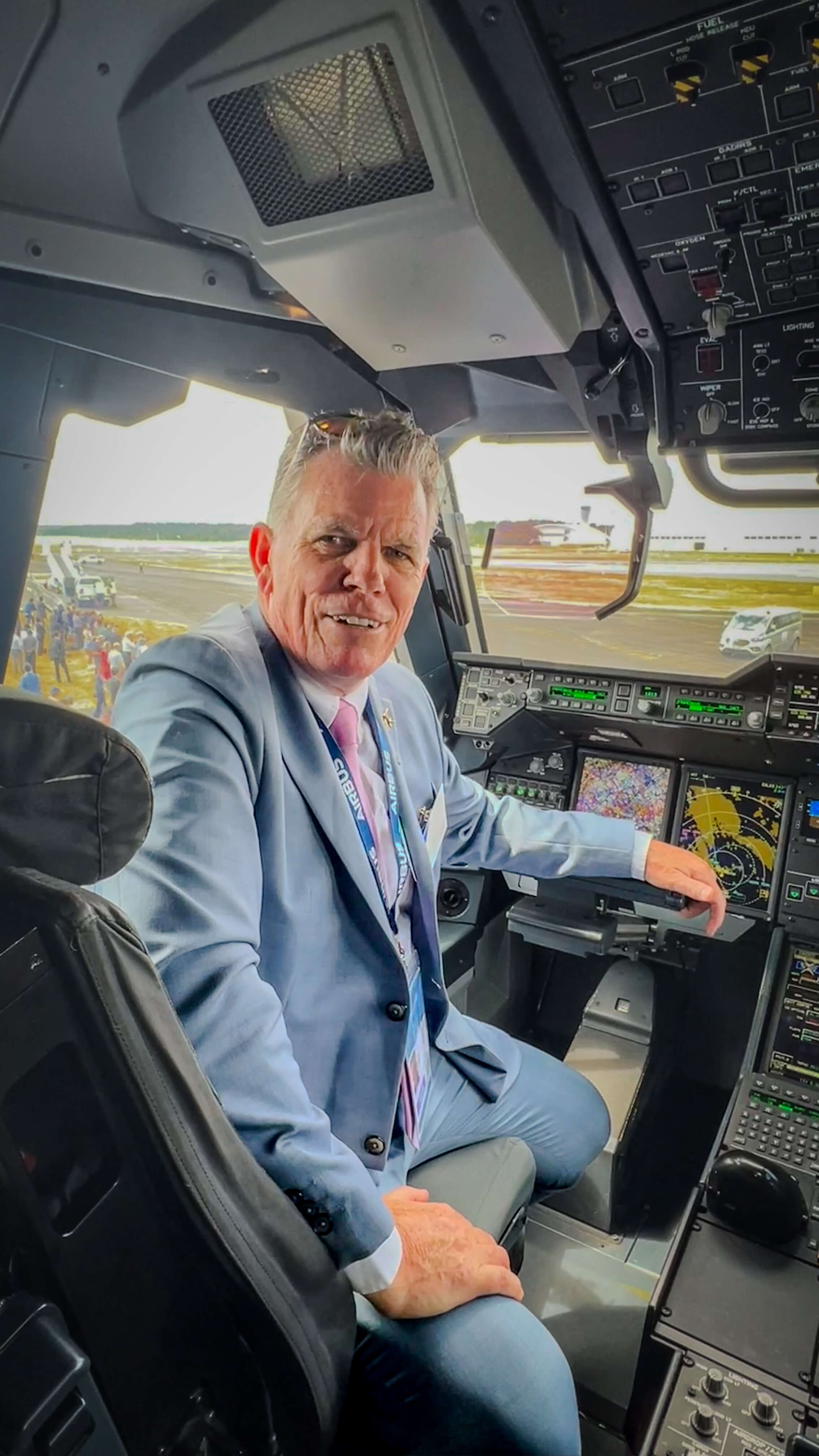
Captain Chris Pohl

Fleet Commander // Educator

Hours

28K+

Status

Active

// The Origin Story

At twelve years old, sitting in the cockpit of a Trans Australian Airways (TAA) Boeing 727 during a family holiday from Melbourne to Coolangatta, I knew my destiny had been set. In that brief moment, surrounded by panels of dials, switches and instruments, the hum of the old systems, and the quiet confidence of the three-man crew, a spark was lit.

// The Journey

My aviation journey began unconventionally. After earning my commercial licence at nineteen, I flew human remains for funeral directors, because, as I quickly learned, dead people don't complain about inexperienced young pilots. I towed targets for the Royal Australian Navy while they fired live ammunition at me. I flew night freight, charter, and bush operations across the vastness of Australia.

// The Realisation

Those first three thousand hours of GA (General Aviation) solo flying shaped me in ways no classroom ever could. They taught me discipline, respect for the weather and the aircraft, decision-making under pressure, resilience and something far more important: Every pilot, including me, experiences fear when learning to fly. Fear isn't weakness. Fear is a natural response to the unfamiliar. It is only through education, repetition, and experience that fear is replaced with confidence and calm.

// The Mission

Across millions of miles, tens of thousands of flight hours, and the privilege of training hundreds of pilots, one truth has remained constant: Knowledge conquers fear.

If you are reading this, there's a good chance that flying makes you uncomfortable, nervous, or even terrified. Let me reassure you: You are not alone. And you are not broken.

Fear of flying is one of the most common fears in the world, not because flying is dangerous, but because it removes our sense of control and places us into an environment we don't fully understand. This guide is here to replace imagination with understanding.